


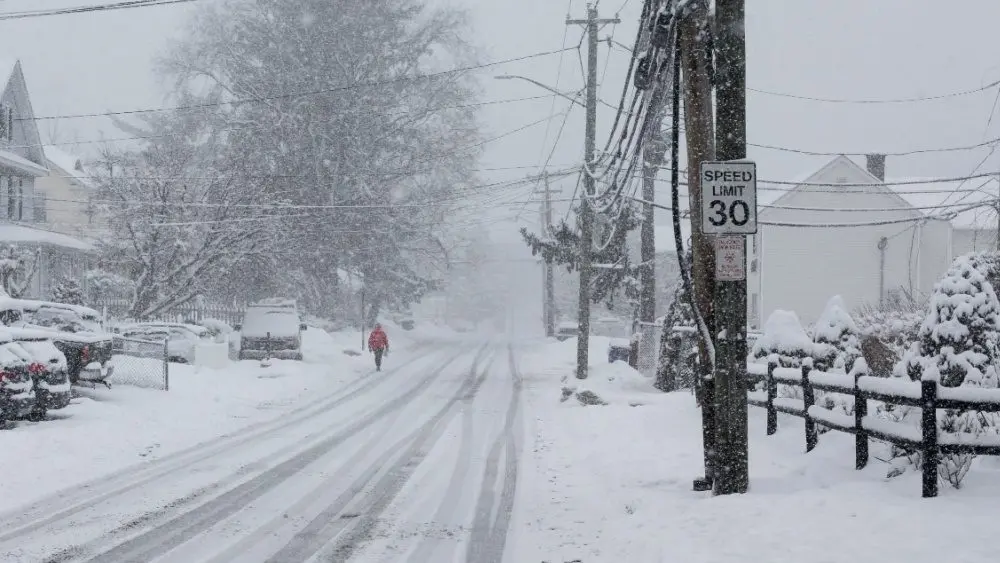
A sprawling and unusually powerful winter storm has battered vast portions of the United States, coating roads in dangerous ice, burying cities under heavy snow, and plunging temperatures to life-threatening lows. The system has knocked out electricity for more than one million customers across the mid-Atlantic, South, and Midwest, while disrupting travel nationwide and forcing widespread closures.
The storm has also proven deadly, with at least seven people dead nationwide in connection with the extreme cold, including two men in Louisiana whose deaths were attributed to hypothermia. Officials fear the toll could rise as freezing temperatures persist and many residents remain without heat or shelter.
Utility tracking site PowerOutage.us reported that more than 1,018,000 customers were without power Sunday afternoon, with Tennessee, Mississippi, and Louisiana among the hardest-hit states. Tennessee alone saw roughly 306,700 outages, followed by Mississippi with about 175,300 and Louisiana with around 145,100. Texas, Georgia, Kentucky, West Virginia, Alabama, and Virginia also reported tens of thousands of customers in the dark. Officials warned that restoration efforts could take days in some areas, especially where thick ice has brought down trees and power lines.
In Nashville, nearly 200,000 customers lost electricity, and the local utility cautioned that repairs could extend well into the week. In Shelby County, Texas, heavy ice snapped tree branches and toppled power lines, leaving about one-third of the county without electricity. In Louisville, Kentucky, authorities responded to more than 850 calls related to crashes, stranded drivers, and cold exposure. Virginia State Police reported handling at least 177 accidents, including 14 that caused injuries.
Across the Midwest, wind chills plunged as low as minus 40 degrees Fahrenheit, creating conditions where frostbite can develop within minutes. Rhinelander, Wisconsin, recorded a reading of minus 36 degrees early Saturday — its coldest temperature in nearly three decades. Meteorologists warned that the frigid air mass trailing the storm would prolong hazardous conditions and slow recovery efforts. “The snow and the ice will be very, very slow to melt and won’t be going away anytime soon, and that’s going to hinder any recovery efforts,” said Allison Santorelli of the National Weather Service.
Air travel was also thrown into chaos as airports struggled to keep runways clear. More than 17,000 flights were canceled over the weekend, including over 10,000 on Sunday alone, with an additional 2,000 already called off for Monday. Schools in major cities from Texas to the Northeast closed or shifted to remote learning, while universities in states such as North Carolina and Mississippi canceled classes.
As the storm advanced northeast, heavy snow blanketed the densely populated Interstate 95 corridor. Boston braced for up to 23 inches, a total that could place the city among its top 10 two-day snowfalls on record, approaching the historic benchmark of 27.6 inches. In addition, officials across New Jersey and New York urged residents to avoid travel. Forecasters described the massive storm as affecting a stretch of nearly 2,000 miles from the southern Rockies to New England.
Nearly 185 million people across 23 states remain under winter weather alerts or states of emergency, and authorities caution that the danger is far from over. While conditions are expected to gradually improve next week, bitter cold and lingering snow and ice are likely to keep travel hazardous and recovery slow in the days ahead.
Editorial credit: Miro Vrlik Photography / Shutterstock.com